
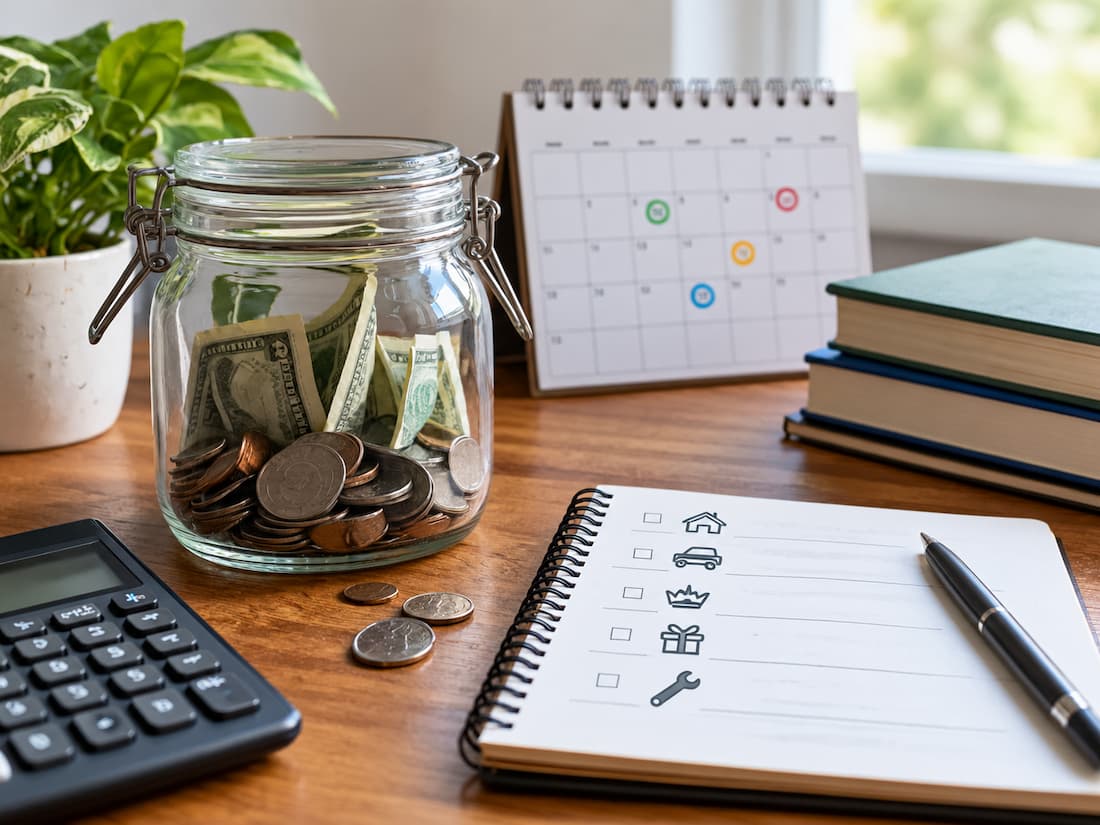
A household budget can look balanced on paper and still be disrupted by a bill that was never truly a surprise. An annual insurance payment, school-related cost, vehicle registration, professional fee, appliance replacement, or seasonal expense may not appear in most monthly budgets. When the bill arrives, however, the money still has to come from somewhere. Without a plan, people often pull from their emergency savings, delay another bill, use a credit card, or treat the expense as an unexpected financial crisis.
A sinking fund is designed for a different situation. It sets aside money gradually for an expense that is expected, even when the exact payment does not occur every month.
The distinction matters because ordinary monthly expenses, predictable irregular expenses, and genuine emergencies serve different purposes. Treating all three the same can make a budget harder to manage than it needs to be.
What Is a Sinking Fund?
A sinking fund is money set aside over time for a known or reasonably foreseeable expense that will occur later. Suppose a household expects to spend $600 on vehicle insurance once a year. Instead of trying to find the entire $600 in the month the payment is due, the household could set aside $50 per month. After 12 months, the fund would contain $600, assuming no withdrawals and ignoring any interest.
The idea is simple: the expense is divided across the period before it is needed. A sinking fund does not necessarily require a separate bank account for every expense. A household might use several labeled savings categories within one account, a budgeting app, a spreadsheet, or another tracking method. The important part is that the money is mentally and practically reserved for its intended purpose.
The Consumer Financial Protection Bureau recommends reviewing several months of spending because less frequent expenses such as insurance payments, medical costs, school expenses, gifts, and seasonal costs can otherwise be missed in a monthly budget.
Sinking Funds, Monthly Expenses, and Emergency Savings Are Different
The easiest way to understand a sinking fund is to compare it with the other two categories.
- Ordinary monthly expenses are costs that normally belong in the current month’s budget. Rent, groceries, internet service, and a regular loan payment are examples. You generally expect the bill and plan to pay it from current income.
- Predictable irregular expenses happen less frequently but can usually be anticipated. Annual insurance, school supplies, a recurring professional license, holiday spending, or a planned vehicle registration payment may fit this category. The timing or amount may vary, but there is enough information to plan for them.
- Emergency expenses are different because they are genuinely unplanned or unexpected. A sudden medical expense, an unexpected loss of income, or an urgent repair may require money that was not allocated to a specific upcoming bill. The CFPB describes emergency savings as a reserve for unplanned expenses and financial emergencies.
This distinction prevents a common problem: using emergency savings for expenses that were foreseeable simply because they did not occur every month. A sinking fund does not replace an emergency fund. Instead, it can reduce the number of predictable expenses that compete with emergency savings.
Which Expenses Can Belong in a Sinking Fund?
A useful candidate usually has three characteristics: you can reasonably expect it, it does not need to be paid every month, and you can estimate its timing or cost well enough to save toward it.
Examples may include:
- Annual insurance payments
- Vehicle registration or inspection costs
- School-related expenses
- Professional membership or licensing fees
- Seasonal clothing or household purchases
- Planned gifts
- Regular property or equipment maintenance
- Annual subscriptions
- Expected travel connected to family or work commitments
- Replacement of an item that has a reasonably predictable useful life
Not every future purchase deserves its own fund. The goal is not to create dozens of tiny savings accounts. It is to identify expenses that repeatedly disrupt the monthly budget when they arrive.
Start by Looking Back, Not Guessing Forward
One of the most useful ways to identify sinking-fund needs is to examine actual spending from the previous 12 months. Look through bank statements, payment histories, receipts, and existing budget records. Search for payments that appeared once, twice, or only during a particular season.
For each expense, record:
- What the expense was.
- When it occurred.
- How much it cost.
- Whether it is likely to happen again.
- Whether the amount is fixed, variable, or uncertain.
A 12-month review is especially useful because a three-month budget can easily miss annual payments. The CFPB similarly recommends looking over several months of spending to identify less frequent expenses that may otherwise be overlooked. The review can also reveal expenses that should not become sinking funds. If a purchase was completely optional and unlikely to recur, creating a permanent category for it may add unnecessary complexity.
Turn an Occasional Bill Into a Monthly Contribution
Once an expense has been identified, the basic calculation is straightforward:
Estimated cost ÷ months until the expense = monthly contribution
For example, suppose a household expects a $720 annual expense and has 12 months to prepare.
$720 ÷ 12 = $60 per month
If the same household has only six months before a $900 payment:
$900 ÷ 6 = $150 per month
The calculation becomes more useful when the expense is not exactly annual.
Imagine a $450 expense expected in nine months:
$450 ÷ 9 = $50 per month
This approach changes the question from “Where will I find $450 when the bill arrives?” to “Can my current budget consistently reserve $50 each month?”
That is a much more manageable budgeting decision.
Estimating a Cost When the Final Amount Is Uncertain
Some sinking-fund expenses have no exact price. A vehicle maintenance bill might be higher than last year’s. School expenses can change. A yearly subscription may increase in price. A planned household replacement may cost more by the time it is needed. In these cases, use a reasonable planning estimate rather than pretending the final amount is known.
Suppose previous maintenance costs were $280, $330, and $310. A household might choose a planning target somewhat above those recent costs rather than automatically saving exactly $310.
If the target is $360 and the expense is expected in 12 months:
$360 ÷ 12 = $30 per month
The objective is not to predict the future perfectly. It is to create a useful reserve based on available evidence.
For expenses with particularly wide cost ranges, it can also help to separate the predictable base amount from the uncertain portion. For example, if an annual fee is normally $200 but could reach $250, the household could plan around the higher figure if its budget permits.
What If Several Sinking Funds Compete for the Same Income?
This is where sinking funds become a budgeting decision rather than a simple savings exercise.
Suppose a household calculates that it needs:
- $60 per month for annual insurance
- $50 for school expenses
- $40 for vehicle maintenance
- $30 for annual subscriptions
- $75 for gifts and seasonal spending
That totals $255 per month.
If only $150 is realistically available, simply declaring that all five funds need their full contributions does not solve the problem. The household has to prioritize. Start with expenses that are unavoidable or have firm deadlines. Then consider expenses that can be reduced, delayed, or funded through other means. Some categories may need smaller monthly contributions, a longer preparation period, or a lower spending target.
For example, an annual gift budget of $900 could become $600, reducing its monthly contribution from $75 to $50. That does not make the original $900 target wrong; it simply recognizes the limits of the current budget.
A budget should reflect what the household can actually afford, not only what it would ideally like to fund. For people whose income changes from month to month, deciding on a consistent sinking-fund contribution can be harder. Interest-Story.com’s Irregular Income Budget Planner may be useful for thinking through available income when deciding how much can realistically be allocated toward planned expenses. The tool’s name indicates its focus on irregular income budgeting; it should not be treated as a substitute for calculating the actual cost or timing of a particular sinking-fund goal.
What Happens If the Expense Comes Earlier Than Expected?
Timing problems can expose weaknesses in a sinking fund. Suppose you planned to save $600 over 12 months, but the payment is suddenly required after eight months. At $50 per month, you have saved only $400. The correct response is not to pretend the fund is fully funded. The household has a shortfall of $200.
Possible responses depend on the circumstances. The payment might be reduced, postponed, covered partly from another available category, or temporarily supported by another source of cash. If the expense is genuinely unexpected rather than merely early, emergency savings may be relevant.
This is another reason not to define an emergency fund as “money for anything I forgot to save for.” An emergency reserve exists for genuine financial shocks. The CFPB notes that emergency savings can help households recover from unplanned expenses without necessarily turning to credit or loans.
What Should Happen to Leftover Money?
Sinking funds do not always end with an exact zero balance. Suppose you saved $600 for an expense and the final bill was $540. You have $60 remaining. That money does not need to disappear from the budget. It can remain in the category as a cushion for the next occurrence, be added to another related goal, or be redirected after reviewing the household’s priorities.
Keeping a small surplus can actually make future contributions easier when the cost tends to fluctuate. For a recurring annual expense, it may make sense to leave the fund open and continue contributing for the following year. The next cycle then begins with money already available rather than starting from zero.
Common Sinking-Fund Mistakes
One mistake is treating every non-monthly purchase as a sinking fund. A sinking fund is most useful when the expense is sufficiently predictable to plan for. Another mistake is using an outdated estimate. If an expense has risen from $400 to $550 over several years, continuing to contribute based on the old figure creates a predictable shortfall.
A third mistake is ignoring timing. Saving $600 eventually is not enough if the $600 payment is due next month. Some households also create too many categories. A dozen tiny funds can make budgeting harder to maintain. Grouping similar expenses into a broader category may be more practical. Finally, a sinking fund should not be used to disguise ordinary overspending. If groceries repeatedly exceed the monthly budget, creating a “grocery sinking fund” does not solve the underlying issue. Sinking funds are for expenses whose timing differs from the normal monthly pattern.
When a Sinking Fund May Not Be Necessary
Not every irregular expense requires a dedicated fund. A small expense that occurs infrequently may be easy to absorb within a normal monthly budget. Likewise, creating a separate fund for every minor purchase can add more tracking work than financial value.
A sinking fund becomes more useful when the expense is large enough to disrupt the monthly budget, predictable enough to plan for, and recurring or important enough to justify preparation. There is also no requirement to give every category a formal name. The principle matters more than the label: money intended for a future predictable expense should be considered before that expense arrives.
A Worked Example: Several Expenses, One Household Budget
Consider a fictional household that reviews its previous year’s spending and identifies three recurring costs:
- Annual insurance: $720, due in 10 months
- School expenses: $480, due in eight months
- Vehicle maintenance: estimated $360, expected within 12 months
The required monthly contributions are:
Insurance: $720 ÷ 10 = $72
School expenses: $480 ÷ 8 = $60
Vehicle maintenance: $360 ÷ 12 = $30
The household therefore needs to reserve approximately $162 per month for these three purposes. Now suppose only $130 per month is available.
The shortfall is $32 per month. That is useful information. It tells the household that the original plan is not fully affordable under current conditions. The household could examine whether the school target can be reduced, whether the insurance contribution needs to be accelerated because of its earlier due date, whether existing savings can cover part of one expense, or whether another part of the budget needs to change.
The important point is that the sinking-fund calculation has exposed the problem before the bills arrive. That is the real value of the method. It turns irregular expenses into visible future commitments instead of allowing them to appear as monthly-budget surprises.
Keep the Emergency Fund for Genuine Financial Shocks
Sinking funds and emergency savings work alongside each other. A sinking fund says, “I expect this expense and am preparing for it.”
An emergency fund says, “I do not know exactly when this financial shock will happen, but I want a reserve available if it does.”
The CFPB recommends establishing guidelines for what qualifies as an emergency and emphasizes that emergency savings are intended for unplanned expenses. Interest-Story.com’s Emergency Fund Target Planner may be useful when considering the separate role of emergency savings. It can be used alongside, rather than instead of, planning for predictable irregular expenses.
Keeping these purposes separate can make the household budget easier to understand. Money reserved for next year’s insurance should not be confused with money intended to absorb an unexpected financial shock.
A Sinking Fund Is a Planning System, Not a Promise of Perfect Predictability
Future expenses will not always behave exactly as expected. Bills can arrive early, prices can change, income can fluctuate, and priorities can shift. That does not make sinking funds ineffective. It means they should be reviewed rather than treated as fixed forever. The practical process is relatively simple: examine past spending, identify predictable irregular expenses, estimate realistic future costs, calculate the time available, and compare the required contributions with what the household can actually afford.
The result is not a guarantee that every future bill will be covered. It is a way to recognize expenses before they arrive and give them a place in the budget. For many households, that distinction can be the difference between an expense being inconvenient and an expense becoming a financial disruption.

The Interest-Story Editorial Team creates practical financial guides covering budgeting, saving, debt, credit, side income, student finance, and everyday financial planning. Our content is written to make complicated financial topics easier to understand, with information organized around real-life questions and decisions. We use reliable sources for facts that can change over time and encourage readers to verify important financial, legal, and government requirements with the appropriate official organization. Our goal is straightforward: provide useful information that helps readers understand their options and make more informed financial decisions.