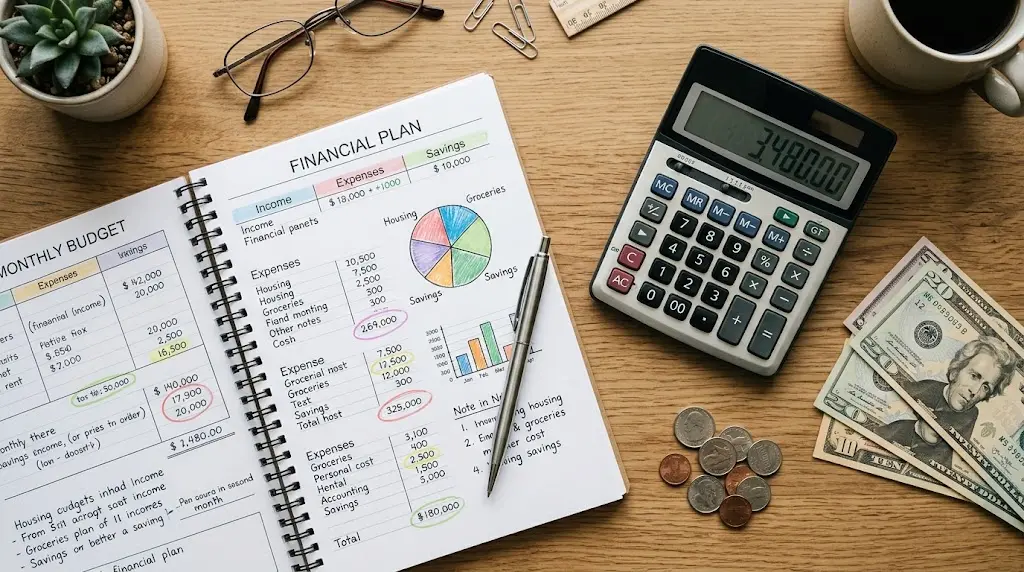
If you are a freelancer, independent contractor, commission-based earner, or someone who works variable hours, you know exactly how stressful the first of the month can be. Traditional budgeting advice usually starts with a simple step: “Write down your monthly income.” But what happens when you have absolutely no idea what your next paycheck will look like?
Budgeting for an irregular income requires a completely different rulebook. When your cash flow resembles a rollercoaster—soaring one month and dipping dangerously low the next—relying on a standard budgeting template can lead to overdrafts, missed payments, and constant anxiety.
In this comprehensive guide, we will break down exactly how to build a resilient budget that survives fluctuating earnings and changing monthly expenses.
Why Traditional Budgets Fail Irregular Earners
Most budgeting apps and financial gurus assume you receive a predictable, identical deposit every two weeks. When you have a steady salary, you can easily allocate exact percentages to rent, groceries, and savings.
However, if your income fluctuates, treating a high-earning month as your “new normal” is a critical mistake. If you upgrade your lifestyle based on a $6,000 month, a subsequent $2,500 month will instantly force you into credit card debt just to keep the lights on.
To break this cycle, you have to stop budgeting based on what you hope to earn and start budgeting based on your absolute minimum baseline.
Step 1: Determine Your Absolute “Floor” (Baseline Expenses)
The foundation of an irregular income budget is your “floor.” Your floor is the absolute bare minimum amount of money you need to survive a month without relying on credit cards.
To calculate your baseline floor, list only your essential, non-negotiable expenses:
-
Housing: Rent or mortgage payments.
-
Utilities: Electricity, water, internet (especially if you work from home), and phone bills.
-
Food: Basic groceries (this does not include dining out, coffee runs, or food delivery).
-
Transportation: Gas, basic car maintenance, or public transit passes.
-
Debt Minimums: The minimum payments required to keep your credit cards or student loans out of default.
-
Insurance: Health, auto, and renter’s/homeowner’s insurance.
Action Step: Add these numbers up. Let’s say your total baseline survival number is $2,200. This means that regardless of whether you make $2,500 or $8,000 this month, your first $2,200 is already spoken for.
Step 2: Establish Your Baseline Income
Once you know your minimum expenses, you need to determine your baseline income. Look back at your bank statements or invoicing software over the last 12 to 18 months.
Find the lowest-earning month you had during that period.
Many irregular earners make the mistake of calculating their average monthly income. While averages are helpful for long-term planning, they are dangerous for short-term survival. If your average income is $4,000, but you frequently have months where you only bring in $2,500, budgeting for $4,000 will leave you short.
Always build your core budget around your lowest expected income. If your lowest month was $2,500, and your essential expenses are $2,200, you know that even in your worst-case scenario, you can survive without going into debt.
Step 3: Create a “Prioritized List” for the Surplus
If you build your budget around your lowest earning month, what happens when you have a phenomenal month and bring in double your baseline? This is where the magic of the irregular income budget happens.
Instead of treating that surplus cash as instant spending money, you need a prioritized “waterfall” list. A waterfall list tells your extra money exactly where to go, in order of importance, until the money runs out.
Here is an example of a healthy surplus priority list:
-
Fund Your “Valley” Account (Income Buffer): The first priority for surplus cash should be building a dedicated buffer account. This account acts as a shock absorber. When a low-income month hits, you transfer money from the Valley Account to cover your bills.
-
Fully Fund an Emergency Reserve: Separate from your income buffer, you need a true emergency fund (covering 3 to 6 months of baseline expenses) for massive unexpected events like medical emergencies or sudden car engine failure.
-
Tackle High-Interest Debt: Once your safety nets are in place, aggressively throw extra cash at high-interest credit card debt or personal loans.
-
Invest for the Future: Freelancers and contractors often lack employer-sponsored 401(k) matches. Direct surplus funds into an IRA or individual investment account.
-
Discretionary Lifestyle Spending: Finally, allocate the remaining funds to dining out, vacations, new clothes, or entertainment.
When a $6,000 check arrives, you don’t guess what to do with the extra $3,800. You simply pour it down your priority list.
Step 4: The Ultimate Goal – “Living One Month Behind”
The holy grail of budgeting with an irregular income is learning to live one month behind. Also known as “aging your money,” this strategy completely eliminates cash-flow anxiety.
Living one month behind means you pay this month’s bills using last month’s income.
For example, all the money you earn in October is deposited into a holding account. You do not touch a single cent of it. When November 1st arrives, you transfer October’s total earnings into your checking account to fund November’s budget.
Why is this so powerful?
-
You know exactly, down to the penny, how much money you have to budget for the current month.
-
You are no longer waiting anxiously for an invoice to clear so you can pay your rent on the 5th.
-
It turns an irregular, unpredictable cash flow into a fixed, predictable monthly “salary” that you pay yourself.
Reaching this stage takes time. It requires discipline during your high-earning months to stockpile that money rather than spending it. But once you achieve it, financial stress plummets.
Step 5: How to Handle Constantly Changing Expenses
An irregular income is only half of the challenge; often, expenses change wildly from month to month as well. You might have quarterly tax payments, annual software subscriptions, or seasonal heating bills.
To prevent changing expenses from blowing up your budget, use Sinking Funds.
A sinking fund is a strategic savings account designed for a specific, known future expense. Instead of scrambling to find $600 when your car insurance is due in six months, you treat it like a monthly bill. You save $100 every month into a dedicated “Car Insurance” sinking fund. When the bill arrives, the money is already there waiting for you.
You should create sinking funds for:
-
Estimated quarterly taxes (crucial for freelancers!)
-
Annual subscriptions and memberships
-
Holiday gifts and travel
-
Routine medical or dental visits
The Bottom Line
Budgeting for an irregular income isn’t about restricting yourself; it is about protecting your peace of mind. By anchoring your budget to your baseline floor, prioritizing your surplus cash, and using sinking funds to smooth out changing expenses, you can take control of your finances—no matter what your next paycheck looks like.
Stop stressing over unpredictable invoices and start building a budget that works for you, in both the peaks and the valleys.

“Hi, I’m David Caldwell. I know exactly what it feels like to be stressed about money and unexpected debt. I started Interest-Story to share the practical budgeting tips, side hustle strategies, and debt-payoff methods that actually worked for me. No confusing financial jargon—just real, tested advice for everyday people trying to take control of their finances.”