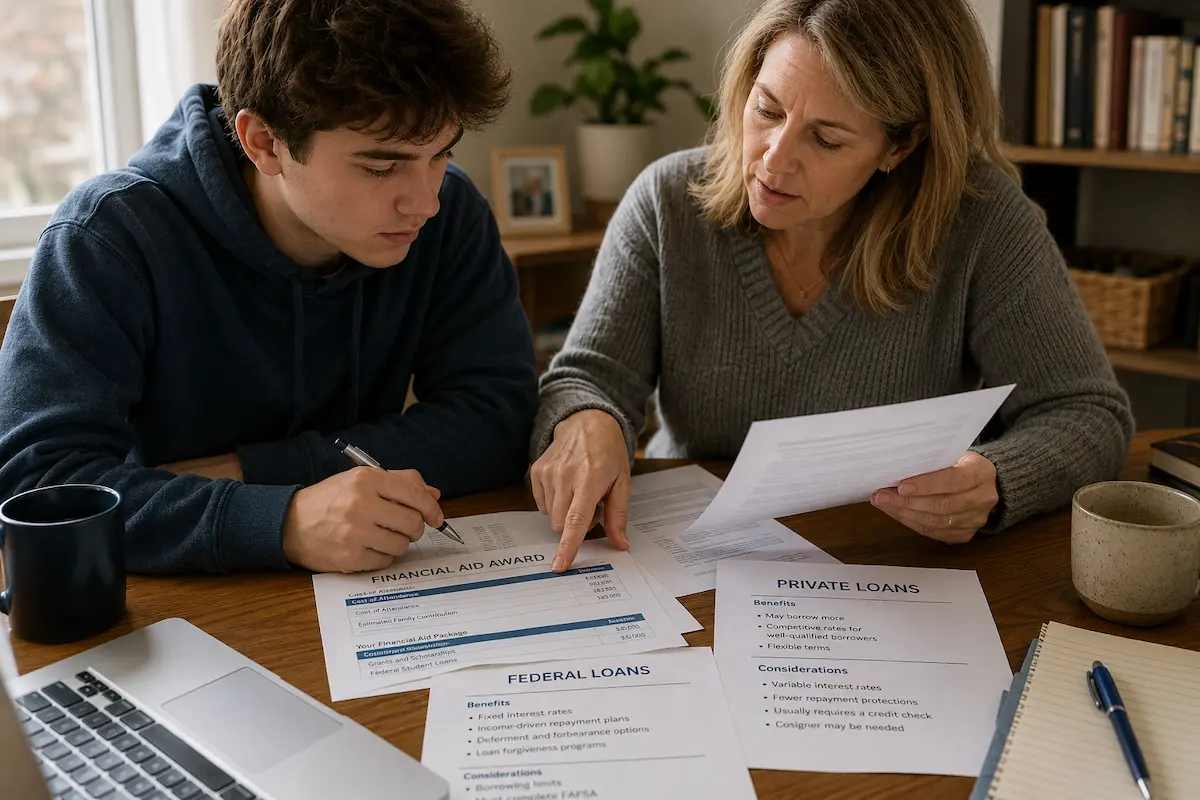
Seventeen years old, acceptance letter in hand, financial aid package still weeks away. That’s the moment most families first confront the student loan question. Federal or private? The answer seems obvious until you look closer. Federal loans come with protections that private lenders can’t match, but private loans sometimes fill gaps that federal caps create. The “right” choice depends on your specific circumstances, your family’s financial picture, and how much risk you’re willing to carry into your twenties and thirties.
This isn’t a rah-rah piece about avoiding all debt. For many students, loans are the bridge between aspiration and access. The goal is crossing that bridge without it collapsing underneath you.
The Landscape: What Actually Exists
Federal student loans originate with the U.S. Department of Education. You apply through the Free Application for Federal Student Aid (FAFSA), and eligibility isn’t based on credit history or income for most undergraduate borrowers. The government sets the interest rates, which are fixed for the life of the loan. Repayment options are extensive, forgiveness programs exist for specific career paths, and deferment or forbearance is available during hardship.
Private student loans come from banks, credit unions, and online lenders. They function more like personal loans or auto loans. Your interest rate depends on your credit score (or your cosigner’s), your income, and sometimes your field of study. Rates can be fixed or variable. Terms vary by lender. Protections are minimal compared to federal options.
Most financial aid offices recommend exhausting federal options before touching private loans. This is sound general advice, but it doesn’t account for every situation. Understanding when private loans make sense — and when they’re financial poison — requires looking at the details most gloss over.
What I Learned the Hard Way: A friend maxed out federal loans for her first two years of college, then discovered her program required an expensive fifth year for certification. Federal undergraduate aggregate limits stopped her cold. She took private loans for that final year at 11% variable interest because she was already committed and had no other funding source. The variable rate climbed to 14% within three years. If she’d understood the federal cap earlier, she might have borrowed less aggressively in years one and two, preserving federal capacity for the expensive finish.
Federal Loan Types: The Menu
Not all federal loans are created equal. The Department of Education offers several programs with different terms, and choosing among them matters.
Direct Subsidized Loans: Available to undergraduate students with demonstrated financial need. The government pays interest while you’re in school at least half-time, during the six-month grace period after leaving school, and during deferment. This is essentially free money during those periods. If you qualify, take the maximum before anything else.
Direct Unsubsidized Loans: Available to undergraduate and graduate students regardless of financial need. Interest accrues from the day the loan disburses, including while you’re in school. You can pay interest as it accrues or let it capitalize (add to principal) when repayment begins. Letting it capitalize is expensive — $5,000 in accrued interest becomes part of your principal, and future interest calculates on that larger number.
Direct PLUS Loans: Available to graduate students and parents of dependent undergraduates. Credit check required, though the standard is lenient. Interest rates are higher than other federal loans — 8.05% for 2023–2024 versus 5.50% for undergraduate Direct Loans. Origination fees exceed 4%, deducted before funds reach the school. These fill gaps but at a premium.
| Feature | Direct Subsidized | Direct Unsubsidized | Direct PLUS |
|---|---|---|---|
| Who qualifies | Undergrads with financial need | Undergrads and grads; no need requirement | Grad students; parents of dependent undergrads |
| Interest while in school | Government pays it | You pay it (or it capitalizes) | You pay it (or it capitalizes) |
| 2023–2024 interest rate | 5.50% fixed | 5.50% (undergrad); 7.05% (grad) fixed | 8.05% fixed |
| Origination fee | 1.057% | 1.057% | 4.228% |
| Annual loan limit | $3,500–$5,500 depending on year | $5,500–$20,500 depending on year and dependency status | Cost of attendance minus other aid received |
| Aggregate limit | $23,000 | $31,000 (dependent undergrads); $57,500 (independent undergrads) | None |
When Private Loans Enter the Conversation
Private loans shouldn’t be your first move. But they shouldn’t be dismissed entirely either. There are narrow corridors where they make sense.
A graduate student with excellent credit and a high-earning career path (medicine, dentistry, law at a top school) might secure private loans at rates below federal PLUS loans. A parent with stellar credit might cosign a private loan at 4% fixed rather than taking a Parent PLUS loan at 8% with a 4% origination fee. In these cases, the math favors private — but only if the borrower understands what they’re giving up.
The protections you’re trading away include:
— Income-driven repayment plans that cap monthly payments at 10–20% of discretionary income
— Loan forgiveness after 20–25 years of qualifying payments under income-driven plans
— Public Service Loan Forgiveness for government and nonprofit workers after 10 years
— Generous deferment and forbearance options during unemployment or economic hardship
— Death and disability discharge (federal loans are canceled if the borrower dies; private loans may still be owed by cosigners or estates)
— Fixed interest rates that never change, even if your credit improves dramatically
Some private lenders now offer limited forbearance or death discharge, but these are voluntary policies that can change. Federal protections are statutory — written into law, not subject to a lender’s quarterly business decisions.
Pro Tip: If you’re considering private loans because of lower advertised rates, read the fine print on variable rates. A 3.5% variable rate today with a cap of 18% and annual adjustment based on LIBOR or SOFR can become a 12% rate within five years if interest rates climb. Fixed-rate private loans eliminate this risk but typically start higher. Know which you’re signing and what the worst-case scenario looks like.
The Cosigner Trap
Most undergraduates lack the credit history to qualify for private loans without a cosigner. The cosigner — usually a parent — becomes equally liable for the debt. This sounds like a formality until it isn’t.
If the student dies, some private lenders demand full repayment from the cosigner immediately. Others offer death discharge, but policies vary and change. If the student defaults, the cosigner’s credit is damaged. If the cosigner wants to be released from the obligation, most lenders require 12–48 months of consecutive on-time payments plus a new credit check proving the student can handle the debt alone. Many borrowers never qualify for release.
Before cosigning, parents should ask: “Can I afford to pay this entire loan if my child cannot?” If the answer is no, don’t sign. The emotional desire to help shouldn’t override financial reality.
Interest Rate Math: A Concrete Example
Numbers clarify what words obscure. Consider a student borrowing $30,000 total for a four-year degree.
Scenario A — All Federal Direct Unsubsidized Loans at 5.50%:
Monthly payment over 10 years: approximately $326
Total repayment: approximately $39,100
Interest paid: approximately $9,100
Scenario B — Private Loan at 7.50% Fixed with Cosigner:
Monthly payment over 10 years: approximately $356
Total repayment: approximately $42,700
Interest paid: approximately $12,700
Scenario C — Private Loan at 4.00% Fixed with Excellent Credit:
Monthly payment over 10 years: approximately $304
Total repayment: approximately $36,400
Interest paid: approximately $6,400
Scenario C saves money but sacrifices all federal protections. Whether that trade makes sense depends on your confidence in your career earnings, your tolerance for risk, and your access to alternative safety nets.
Repayment Realities Nobody Explains at 18
The standard 10-year repayment plan assumes you’ll earn enough to cover $300–$600 monthly payments starting six months after graduation. For graduates in high-demand fields, this works. For graduates in lower-paying fields, or those who struggle to find work, it doesn’t.
Income-driven repayment plans cap federal loan payments at a percentage of discretionary income and extend forgiveness timelines. These plans exist only for federal loans. Private lenders have no equivalent. If you take private loans and your post-graduation income disappoints, your options are limited to whatever forbearance the lender offers — usually measured in months, not years — or default.
Default on federal loans triggers wage garnishment, tax refund seizure, and credit damage. But rehabilitation programs exist to recover. Default on private loans triggers lawsuits, judgment liens, and aggressive collection tactics with fewer pathways back to good standing.
Reality Check: The average bachelor’s degree holder earns significantly more over a lifetime than someone with only a high school diploma. But averages hide enormous variation. A theater degree from an expensive private school financed entirely by loans produces different outcomes than a nursing degree from an in-state public university. Before borrowing anything, research your specific program’s graduate employment rates and starting salaries. The Department of Education’s College Scorecard provides this data free.
Making the Decision: A Framework
There’s no universal answer, but there is a decision tree that clarifies most situations.
Start with the FAFSA every single year, even if you think you won’t qualify for need-based aid. Federal loans don’t require demonstrated need for unsubsidized options, and the application is free. Fill it out early — some aid is first-come, first-served.
Accept all subsidized federal loans offered. This is the best deal available to almost any undergraduate.
Accept unsubsidized federal loans up to your program’s cost of attendance or your aggregate limit, whichever comes first. Pay interest while in school if possible; capitalize it only if there’s genuinely no alternative.
Evaluate Parent PLUS loans if parents are willing and able. Compare the total cost (rate plus origination fee) against private alternatives. For parents with good credit, private loans sometimes win. For parents with marginal credit, PLUS loans are often the only viable option.
Consider private loans only if federal options are exhausted, you or your cosigner have excellent credit, you understand and accept the loss of federal protections, and the rate difference is substantial enough to justify the risk. Even then, borrow the minimum necessary.
Related Articles
- Working During College Without Hurting Your Grades
- How to Rent an Apartment With No Credit History
- Managing Money When Studying Abroad for a Semester
- How to Refinance Student Loans for Better Rates
- Finding Affordable Textbooks Every Single Semester
- How to Handle Finances When Taking a Gap Year
- Preparing for Student Loan Repayment Before Graduation
- How to Build Savings While Paying Off Existing Debt
- How to Prioritize Which Debts to Pay Off First
- Understanding Co-Signed Loans and Your Responsibilities
Sources and References
- U.S. Department of Education. “Federal Student Aid: Types of Financial Aid.” StudentAid.gov, 2024.
- U.S. Department of Education. “Interest Rates and Fees for Federal Student Loans.” StudentAid.gov.
- Consumer Financial Protection Bureau. “Private Student Loans.” ConsumerFinance.gov, 2023.
- Consumer Financial Protection Bureau. “Co-Signing a Loan.” ConsumerFinance.gov.
- Internal Revenue Service. “Student Loan Interest Deduction.” IRS.gov, Publication 970.
- National Consumer Law Center. “Student Loan Borrower Assistance.” StudentLoanBorrowerAssistance.org.
- College Board. “Trends in College Pricing and Student Aid 2023.” Trends.CollegeBoard.org.
- U.S. Department of Education. “College Scorecard.” CollegeScorecard.ed.gov.
This article was written after watching too many young adults sign loan documents they didn’t fully understand, committing to decades of payments for degrees that didn’t deliver promised returns. No financial credentials claimed — just a belief that informed borrowing beats either blind debt or blanket avoidance, and that the details in the fine print matter more than the sales pitch on the brochure.

The Interest-Story Editorial Team creates practical financial guides covering budgeting, saving, debt, credit, side income, student finance, and everyday financial planning. Our content is written to make complicated financial topics easier to understand, with information organized around real-life questions and decisions. We use reliable sources for facts that can change over time and encourage readers to verify important financial, legal, and government requirements with the appropriate official organization. Our goal is straightforward: provide useful information that helps readers understand their options and make more informed financial decisions.