
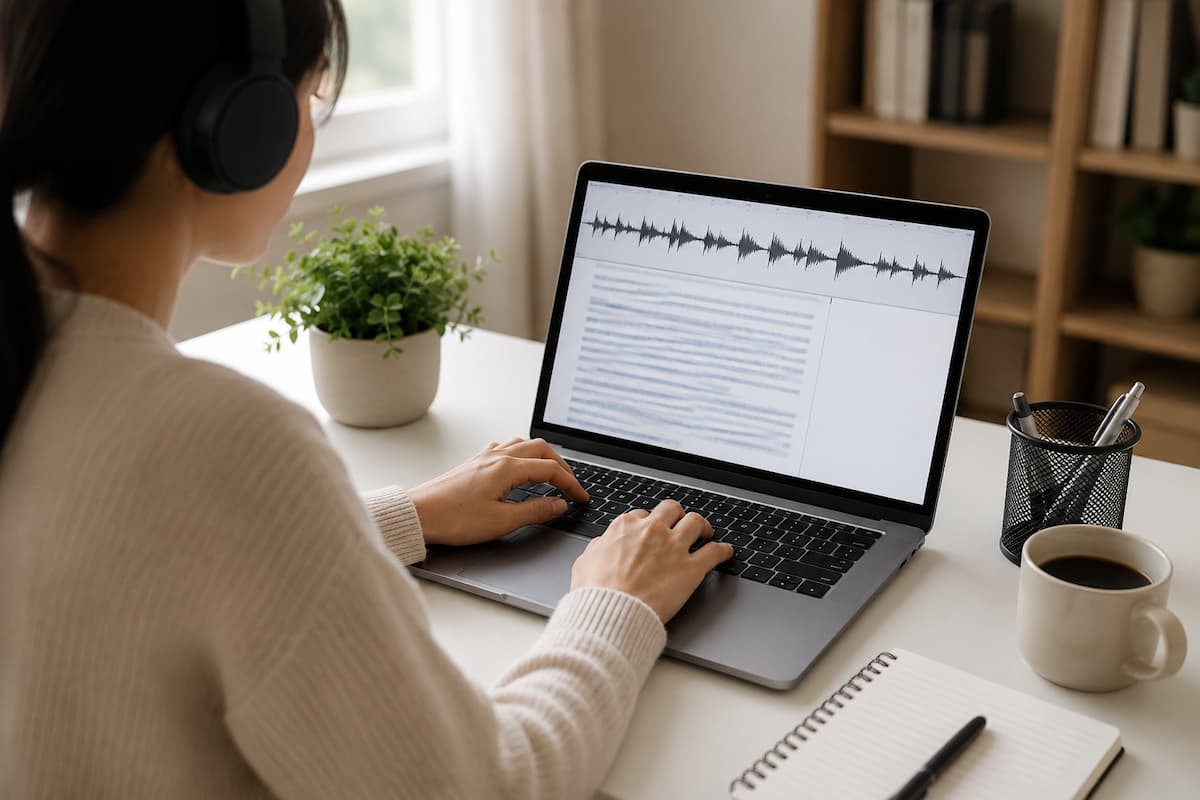
Picture this: you’re sitting at your kitchen table with a cup of coffee, headphones on, converting someone’s spoken words into a clean, readable document—and getting paid for it. That’s transcription work in a nutshell, and if you have strong typing skills, it’s one of the most accessible ways to earn money from home in 2026.
When I first looked into transcription, I assumed it was just “typing what you hear.” I quickly learned that transcription is much more than just typing what you hear. It requires focus, accuracy, and a genuine willingness to improve. The good news? You do not need a college degree, expensive certifications, or years of experience to get started. You just need a decent computer, a reliable internet connection, and the patience to build your skills over time. In this guide, I will walk you through what transcription actually involves, the types of work available, what equipment you need, how much you can realistically earn, and the exact steps to land your first job.
What Is Transcription, Exactly?
Transcription is the process of converting audio or video recordings into written text. A transcriptionist listens to recordings—interviews, podcasts, legal proceedings, medical dictations, or business meetings—and types out the spoken content into a document that accurately reflects what was said.
While artificial intelligence has made strides in speech recognition, human transcriptionists remain essential. AI struggles with accents, background noise, multiple speakers talking over each other, and industry-specific terminology. A skilled human can catch context, identify different speakers, and ensure the final transcript is accurate and professional.
The work itself follows a clear process:
- Listen carefully to the audio or video recording, capturing every spoken word.
- Edit the transcribed text for spelling, grammar, and punctuation errors.
- Format the document with proper paragraphs, speaker labels, and timestamps if required.
- Review the final transcript to ensure it is complete and error-free before submitting.
Types of Transcription Work You Can Pursue
Not all transcription is the same. The field breaks down into several categories, each with different requirements and pay levels.
| Type | What It Involves | Skill Level | Typical Pay Range |
|---|---|---|---|
| General Transcription | Interviews, podcasts, webinars, meetings, and business recordings | Beginner-friendly | $10 – $20 per hour |
| Legal Transcription | Court proceedings, depositions, and legal documents | Intermediate to Advanced | $25 – $50 per hour |
| Medical Transcription | Doctor’s notes, patient records, and medical reports | Advanced (requires training) | $25 – $40 per hour |
| Academic Transcription | Lectures, research interviews, and seminars | Intermediate | $15 – $30 per hour |
| Captioning & Subtitling | Adding captions to videos for accessibility | Beginner to Intermediate | $12 – $25 per hour |
My advice? Start with general transcription. It has the lowest barrier to entry and gives you exposure to different industries. Once you build confidence and speed, you can specialize in legal or medical transcription for significantly higher pay.
Essential Skills Every Transcriptionist Needs
Typing fast is only part of the equation. Here are the core skills that separate decent transcriptionists from great ones:
- Typing Speed and Accuracy: Aim for at least 60 to 70 words per minute with high accuracy. The faster and more accurately you type, the more you earn per hour. Top transcriptionists reach 80 to 90 WPM.
- Active Listening: You need to hear words clearly, even when speakers mumble, talk over each other, or have thick accents. This takes practice.
- Strong Grammar and Punctuation: Clients expect clean, readable transcripts. You must know when to use commas, how to format dialogue, and how to structure sentences properly.
- Attention to Detail: Small errors matter. A misspelled name or incorrect medical term can ruin a transcript’s credibility.
- Time Management: Most jobs have deadlines. You need to estimate how long a file will take and deliver on time.
- Research Skills: You will encounter unfamiliar names, technical terms, and industry jargon. Knowing how to look things up quickly is invaluable.
Equipment and Tools You Actually Need
One of the best things about transcription is the low startup cost. You probably already own the basics. Here is what you need:
- Computer: A reliable laptop or desktop with at least 8GB of RAM.
- High-Speed Internet: For downloading large audio files and submitting work.
- Quality Headphones: Over-ear, noise-cancelling headphones are ideal. They help you catch every word, even in poor-quality recordings.
- Transcription Software: Free tools like Express Scribe or oTranscribe work well for beginners. Some companies provide their own platforms.
- Foot Pedal (Optional): A USB foot pedal lets you pause, rewind, and fast-forward audio without taking your hands off the keyboard. It is a game-changer for efficiency.
- Word Processor: Microsoft Word or Google Docs is standard for most clients.
How Much Can You Realistically Earn?
Let us be honest: transcription will not make you rich overnight. However, it can provide a solid income stream, especially as you gain experience.
Entry-level transcriptionists typically earn between $10 and $15 per hour. This sounds modest, but remember—you are usually paid per audio minute, not per hour worked. A 30-minute audio file might take you 90 minutes to transcribe, so your effective hourly rate depends on your speed.
With experience, specialization, and faster typing speeds, earnings rise. Experienced general transcriptionists can make $18 to $25 per hour, while legal and medical specialists often earn $25 to $50 per hour. According to PayScale, the average hourly pay for a transcriber in 2026 is approximately $22.33, with top earners making over $58 per hour.
Many transcriptionists treat this as a part-time side income, earning $500 to $1,500 per month. Full-time transcriptionists with specialized skills can potentially earn $35,000 to $50,000 annually.
Step-by-Step: How to Get Started
If you are ready to try transcription, here is a practical roadmap:
- Test Your Typing Speed: Use free tools like TypingTest.com or Keybr.com. If you are below 60 WPM, practice daily for 30 minutes until you improve.
- Practice with Real Audio: Transcribe free podcast episodes or TED Talks to get used to different accents and speaking speeds.
- Learn a Style Guide: Most companies follow specific formatting rules. Familiarize yourself with common practices like speaker identification, timestamp placement, and how to mark unclear audio.
- Apply to Entry-Level Platforms: Companies like Rev, TranscribeMe, GoTranscript, and Scribie accept beginners and provide training. These are great places to build your portfolio.
- Take the Required Tests: Most platforms require a typing and grammar test. Prepare by reviewing punctuation rules and practicing transcription-specific typing.
- Deliver Quality Work On Time: Your first few jobs are critical. Meet deadlines, follow instructions precisely, and proofread carefully. Good reviews lead to better-paying assignments.
- Build Your Portfolio: As you gain experience, create sample transcripts to show direct clients. Eventually, you can move beyond platforms and find higher-paying private clients.
Where to Find Legitimate Transcription Jobs
The internet is full of transcription opportunities, but not all are legitimate. Here are trusted places to start:
- Freelance Platforms: Upwork, Fiverr, and Freelancer connect you directly with clients who need one-off or ongoing transcription work.
- Transcription Companies: Rev, TranscribeMe, GoTranscript, Scribie, Daily Transcription, and Speechpad are established companies that regularly hire remote transcriptionists.
- Specialized Platforms: eScribers (legal), 3Play Media (captioning), and Babbletype (market research) cater to specific niches and often pay more.
- Direct Outreach: Once you have samples, reach out to podcasters, YouTubers, researchers, and businesses that might need transcription services.
Common Challenges and How to Overcome Them
Transcription is not always easy. Here are challenges I faced early on and how I dealt with them:
- Poor Audio Quality: Some recordings have background noise, static, or muffled voices. Good headphones help, but sometimes you simply need to mark sections as “inaudible” and move on.
- Thick Accents: Exposure is the only cure. The more accents you transcribe, the better you get at understanding them.
- Repetitive Strain: Typing for hours can strain your wrists and back. Invest in an ergonomic setup, take breaks every hour, and stretch regularly.
- Low Starting Pay: Entry-level rates are not glamorous. View your first month as an investment in learning. Speed and accuracy improve quickly with practice.
Is Transcription Right for You?
Transcription work suits people who enjoy quiet, focused tasks and have the discipline to work independently. It is ideal for stay-at-home parents, students, retirees, or anyone looking for a flexible side income. However, it requires patience. The first few weeks can feel slow and frustrating as you adjust to the rhythm of listening and typing simultaneously.
If you are someone who gets bored easily or needs constant social interaction, transcription might feel isolating. But if you value flexibility, independence, and the satisfaction of turning raw audio into polished text, it is absolutely worth exploring.
Quick Summary
- Transcription converts audio/video into written text and remains in high demand despite AI advancements.
- General transcription is beginner-friendly; legal and medical transcription pays more but requires training.
- Core skills include typing speed (60+ WPM), active listening, grammar, and attention to detail.
- Startup costs are low: a computer, headphones, and free software are enough to begin.
- Earnings range from $10–$15/hour for beginners to $25–$50+/hour for experienced specialists.
- Start with platforms like Rev or TranscribeMe, build a portfolio, then seek direct clients for higher pay.
- Never pay upfront fees, and always verify that a company is legitimate before applying.
References
- Transcription Certification Institute. “How To Get Started As A Transcriptionist – A Complete Free Guide [Part 1].” https://www.transcriptioncertificationinstitute.org/blog/get-started-as-a-transcriptionist-guide-part-1
- Sonix AI. “How to Become a Transcriptionist in 2026: Step-by-Step Guide.” https://sonix.ai/resources/how-to-become-a-transcriptionist/
- Rat Race Rebellion. “14 Non-Phone, Remote Typing Jobs: Legit Options That Pay in 2026.” https://ratracerebellion.com/legitimate-work-from-home-typing-jobs/
- PayScale. “Average Transcriber with Transcription Skills Hourly Pay.” https://www.payscale.com/research/US/Job=Transcriber/Hourly_Rate/36d8a3d9/Transcription
- Rev. “Practice Transcription & Improve Your Skills: A Guide.” https://www.rev.com/blog/how-to-practice-transcription
- Penn Foster. “Guide to Becoming a Medical Transcriptionist: Salary, FAQs, and Requirements.” https://www.pennfoster.edu/blog/guide-to-becoming-a-medical-transcriptionist
- SEEK. “Home-Based Typing Jobs (with Salaries).” “https://au.seek.com/home-based-typing-jobs

Marcus Webb believes money advice should work for regular people, not just the already-wealthy. No Wall Street credentials or certified planner status — just years of researching financial strategies and sharing honest results, including the failures. Articles here are built on verifiable information and tested approaches, written to help readers navigate decisions without confusion or unnecessary complexity.