
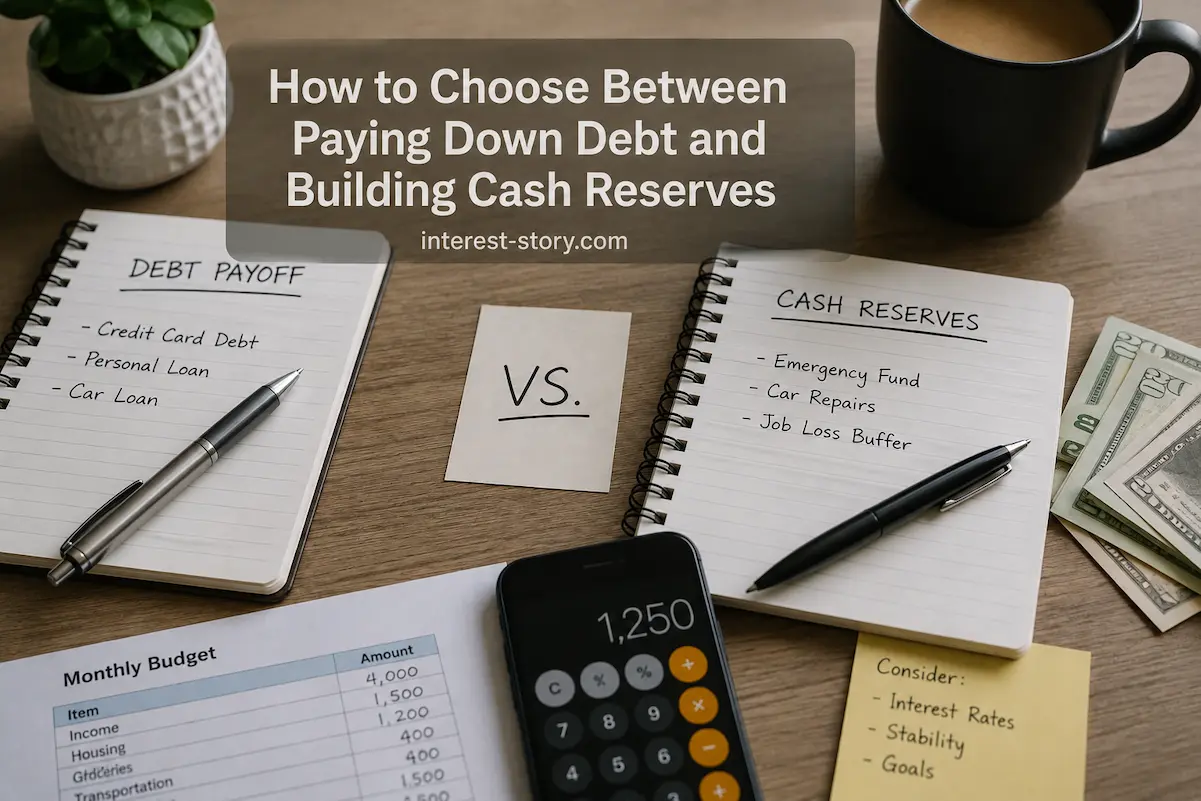
When money is tight, financial priorities can conflict. You may have extra money at the end of the month, but deciding what to do with it isn’t always clear. Should you send the entire amount toward a credit card balance or loan, or should you keep some of it in savings in case something goes wrong? Paying down debt can reduce interest and future payments, while keeping cash available can prevent a new emergency from turning into new debt.
There is no single percentage or formula that works for everyone. The right balance depends on your debt type, income stability, cash on hand, and the likelihood of unexpected expenses. The important thing is to avoid treating debt repayment and cash reserves as completely separate goals. In many situations, a modest cash cushion can make an aggressive debt-payoff plan more sustainable.
The Choice Is Really About Two Different Risks
Debt and savings create different financial pressures. Debt usually has a measurable cost. Interest can accumulate while the balance remains outstanding, and some forms of debt can become significantly more expensive if you miss payments.
Cash reserves solve a different problem. They give you something to use when an expense arrives at an inconvenient time. A broken appliance, urgent travel, temporary income interruption, insurance deductible, or necessary repair does not wait until your debt is paid off.
This creates a genuine tradeoff. Every dollar kept in savings is a dollar that does not reduce the debt balance. But every dollar sent to debt is also a dollar that cannot immediately help if something unexpected happens.
That is why the question should not simply be, “Which one gives me the better return?” A better question is, “Which financial risk would be more damaging if I ignored it right now?”
Start By Looking At The Debt You Actually Have
Not all debt deserves the same treatment. The interest rate is important, but it is not the only factor.
A high-interest revolving balance can become increasingly expensive if it remains unpaid. A lower-interest loan with predictable payments may create less urgency, especially if your income is stable and you already have some cash available.
The structure of the debt also matters. Look at the balance, interest rate, minimum payment, due date, whether the rate can change, and what happens if you miss a payment. A debt that carries serious consequences for missed payments may deserve different attention from one with a predictable repayment schedule.
You should also distinguish between debt that is currently manageable and debt that is already putting pressure on your monthly cash flow. If minimum payments are consuming a large portion of your income, building a financial cushion and reducing the debt may need to happen together rather than one completely before the other.
A Simple Starting Comparison
Before deciding where your next dollar should go, write down the following:
| Question | Why It Matters |
|---|---|
| What is the debt interest rate? | Higher-cost debt can grow faster |
| What is the minimum payment? | Shows the monthly cash-flow commitment |
| Is the rate fixed or variable? | Future costs may change |
| How much cash do I have now? | Determines how vulnerable you are to emergencies |
| How stable is my income? | Uncertain income increases the value of accessible savings |
| What expenses could appear unexpectedly? | Helps estimate your need for liquidity |
This does not produce an automatic answer. It gives you the information needed to make a more realistic decision.
Why Paying Every Extra Dollar Toward Debt Can Backfire
It is easy to see the appeal of putting every spare dollar toward debt. The balance falls faster, interest costs can decrease, and becoming debt-free may move closer.
The problem appears when an emergency arrives before you have any cash available.
Imagine that you have $4,000 in credit card debt and $1,500 in savings. You decide to use the entire $1,500 to reduce the credit card balance. A few weeks later, your car requires a $900 repair that you cannot postpone.
The debt balance is now lower, but you have no cash to pay for the repair. If you put the expense back onto the credit card, some of the progress you made may disappear immediately.
This is why an aggressive debt strategy without any cash reserve can sometimes create a cycle. You pay debt down, an unexpected expense appears, you borrow again, and then you start paying the new balance down.
The issue is not that debt repayment was a bad goal. The issue is that the plan did not account for the possibility of an interruption.
Why Keeping Too Much Cash Can Also Be A Problem
The opposite approach has its own weakness. Someone may become so focused on building savings that they keep accumulating cash while expensive debt continues to generate interest.
Suppose you have several thousand dollars sitting in an ordinary savings account while carrying a credit card balance with a much higher interest rate. Keeping a reasonable reserve can provide security, but continuing to build cash indefinitely may not be an efficient use of every additional dollar.
There is also a psychological element. A large savings balance can feel reassuring even when high-cost debt is quietly working against you.
The answer is not necessarily to empty the savings account and attack the debt. Instead, consider whether your current reserve is large enough to handle the most likely short-term problems. Once you have a reasonable buffer, additional money may be more useful elsewhere.
Your Income Stability Changes The Decision
Someone with a highly predictable salary and someone whose income changes dramatically from month to month may need different levels of cash reserves.
If your paycheck is stable, your essential expenses are relatively predictable, and you have reliable access to income, you may be able to operate with a smaller cash buffer while concentrating more heavily on expensive debt.
If your income varies significantly, however, cash can be more valuable. A slow month can create a problem even without an emergency. In that situation, savings can help smooth the gap between income and essential expenses.
The same principle applies to people whose employment is seasonal, commission-based, contract-based, or dependent on a small number of clients. A reserve is not just emergency money in these situations. It can also function as a cash-flow stabilizer.
Don’t Copy Someone Else’s Emergency Fund Number
You will often see simple recommendations such as saving a certain number of months of expenses. Those can be useful starting points, but they are not universal rules.
Consider two households. One has two stable incomes, low fixed expenses, and family members who could provide temporary assistance. Another depends on one unpredictable income and has several unavoidable monthly payments. They may reasonably need different amounts of accessible cash.
Instead of choosing a savings target because a financial article says you should, think about the situations you are realistically trying to protect yourself against.
What would happen if your income stopped for a month? What if your car broke down? What if you had to travel unexpectedly? What if several smaller expenses arrived during the same month?
Your answers provide more useful information than a generic number.
Build A “Minimum Safety Layer” First
If you currently have no cash reserve at all, you may not need to choose between saving thousands and paying down debt immediately.
A more practical approach can be to establish a small initial reserve while continuing required debt payments. The purpose of this first layer is not to make you financially invincible. It is to create some extra space.
For example, someone might decide that having enough accessible money to handle a modest urgent expense would make their debt repayment plan more sustainable. Once that initial cushion exists, they can direct a larger share of available money toward debt.
The exact amount will vary according to circumstances. The important concept is that a small reserve can protect a much larger repayment effort from being interrupted by an ordinary financial surprise.
Then Consider The Cost Of The Debt
Once you have some liquidity, the interest rate becomes increasingly important.
High-interest debt generally deserves serious attention because the balance can become expensive to carry. Credit cards are a common example, but other forms of costly borrowing can also create significant interest expenses.
Suppose you have $2,000 of available cash beyond what you consider necessary for immediate expenses. Keeping that money in a low-interest account while carrying substantially more expensive debt may not make much sense unless there is a strong reason to maintain the cash.
The key is to compare the value of liquidity with the cost of borrowing.
Cash gives you flexibility and protection. Debt repayment gives you a reduction in future interest and financial obligations. Neither benefit should be ignored.
Consider What Happens After You Make The Payment
One question people often overlook is what their monthly budget will look like after the extra debt payment.
If you make a large payment today but leave yourself with no money for next month’s irregular expenses, you may end up under pressure again very quickly.
Before sending a large extra payment, look ahead. Are property or vehicle costs coming due? Is insurance renewing? Do you have an annual bill approaching? Are there school expenses, travel costs, home repairs, or other known obligations?
A debt payment should be evaluated against your whole cash-flow picture, not just the current account balance.
This is particularly important because a bank balance can look healthy while upcoming commitments are already consuming much of it.
A Split Strategy Can Be More Practical
You do not always have to choose one goal exclusively.
Suppose you have $500 available after covering your normal monthly expenses. You could divide the $500 based on your circumstances, rather than automatically sending it all toward debt or putting it all into savings.
For someone with no emergency reserve and expensive debt, establishing a modest cash cushion may be the priority. Once that exists, a larger percentage might go toward debt.
For someone who already has a reasonable reserve but carries expensive revolving debt, most of the additional money should go toward the balance.
The proportions do not need to remain fixed forever. The strategy can change as your financial situation changes.
Think In Stages Rather Than One Permanent Rule
A useful way to approach the decision is to divide your financial situation into stages.
Stage one: Cover essential bills and required debt payments.
Stage two: Build a modest accessible cash buffer if you currently have none.
Stage three: Direct more available money toward high-cost debt.
Stage four: Once expensive debt is under control, rebuild or strengthen longer-term cash reserves and other financial goals.
This is not a universal financial prescription. It is simply a framework that prevents the common mistake of treating one goal as more important forever.
What If You Have Several Debts?
Multiple debts complicate the decision because there may be several competing interest rates and balances.
You might have a credit card, personal loan, student loan, vehicle loan, and other obligations. In that situation, making extra payments randomly can make it difficult to understand whether your strategy is actually improving your position.
First, maintain all required minimum payments. Then identify which debts are creating the greatest financial cost or risk. If you are considering a formal debt-management strategy, consolidation, refinancing, or another restructuring option, examine the total cost rather than focusing only on the new monthly payment.
A lower monthly payment is not automatically a cheaper arrangement. A longer repayment period can sometimes reduce the immediate monthly burden while increasing the total amount paid over time.
When Your Cash Reserve Is More Important
There are circumstances where maintaining accessible savings deserves greater attention.
Your reserve may be especially valuable if:
- Your income is unpredictable.
- You are the primary income source in your household.
- You have dependents.
- Your essential expenses are difficult to reduce quickly.
- You rely heavily on a work vehicle.
- You have a history of unexpected necessary expenses.
- Your employment situation is uncertain.
- You have very little access to other emergency resources.
Again, this scenario does not mean debt should be ignored. It means liquidity may have greater practical value in your particular situation.
When Debt Reduction May Deserve More Attention
On the other hand, aggressive repayment may become more attractive when:
- You already have a reasonable cash buffer.
- The debt carries a high interest rate.
- Your income is relatively stable.
- Your essential expenses are manageable.
- You have reliable access to additional income if necessary.
- The debt is restricting your monthly cash flow.
- You are repeatedly paying interest without making meaningful progress on the balance.
The important word is “more.” These factors do not automatically mean every dollar should go to debt. They simply shift the balance of the decision.
Avoid Making The Decision Based On Emotion Alone
Debt repayment can provide an immediate sense of progress. Watching a balance fall feels satisfying, while money sitting in savings can feel like it is doing nothing.
The reverse can also happen. Someone may become emotionally attached to a growing savings balance and feel uncomfortable reducing it even when expensive debt remains outstanding.
Try to separate the emotional benefit from the financial function.
Ask yourself what the money is supposed to accomplish. Is it protecting you from an income interruption? Is it preventing new borrowing? Is it reducing expensive interest? Is it freeing monthly cash flow?
Once you identify the purpose, the decision often becomes easier to evaluate.
A Practical Review Before You Choose
Before making your next extra payment or transferring money into savings, take 15 minutes to review your situation.
Look at your current cash balance, essential monthly expenses, debt balances, interest rates, minimum payments, and upcoming irregular expenses. Then consider how stable your income is and what financial problems would be hardest for you to handle without cash.
You can then ask three straightforward questions:
- If an unexpected expense happened next month, could I handle it without borrowing?
- If I keep this debt for another year, how expensive will it be?
- Would making this extra payment leave my normal monthly budget too tight?
The answers will not produce a perfect mathematical solution, but they can reveal whether you are leaning too far toward either extreme.
Frequently Asked Questions
Should I Save Money If I Still Have Debt?
In many situations, having at least some accessible cash while repaying debt can make the overall plan more sustainable. Without any reserve, an unexpected expense may force you to borrow again. The appropriate amount depends on your income stability, expenses, debt costs, and circumstances.
Is It Better To Pay Off Debt Or Build An Emergency Fund First?
There is no universal order. High-cost debt can be expensive to carry, but having no accessible cash can leave you vulnerable to new borrowing. Many people benefit from establishing an initial cash cushion before becoming more aggressive with debt repayment.
Should I Empty My Savings To Pay Off Debt?
Doing so can leave you exposed if an unexpected expense occurs. Before using a large portion of your savings, consider how much cash you would have left afterward and whether you could handle an emergency without immediately taking on new debt.
What If My Debt Has A Very High Interest Rate?
High-interest debt deserves particular attention because the cost of carrying it can accumulate quickly. If you already have adequate short-term liquidity, directing more available money toward that debt may become increasingly attractive.
How Often Should I Reconsider My Strategy?
Your priorities can change as your debt falls, savings grow, income changes, or major life circumstances develop. Reviewing the balance every few months—or whenever your financial situation changes significantly—can help prevent you from following an old plan that no longer fits.
The Best Strategy Can Change Over Time
Choosing between debt repayment and cash reserves is not a one-time decision. Your financial situation moves through different stages, and the right balance can move with it.
Someone starting with no savings and unstable income may place greater value on liquidity. Later, after building a modest reserve, that same person may be in a better position to attack expensive debt. Once the debt is reduced, the priority can shift again toward strengthening savings and other long-term goals.
The important thing is to avoid viewing every available dollar as having only one possible job. Money can protect you from emergencies, reduce future interest, improve monthly cash flow, or support other priorities. Your job is to decide which of those purposes matters most right now.
A strong debt strategy is not necessarily the one that produces the fastest reduction in balance. A strong financial plan reduces debt without leaving you so financially fragile that the next unexpected expense sends you backward.

The Interest-Story Editorial Team creates practical financial guides covering budgeting, saving, debt, credit, side income, student finance, and everyday financial planning. Our content is written to make complicated financial topics easier to understand, with information organized around real-life questions and decisions. We use reliable sources for facts that can change over time and encourage readers to verify important financial, legal, and government requirements with the appropriate official organization. Our goal is straightforward: provide useful information that helps readers understand their options and make more informed financial decisions.