
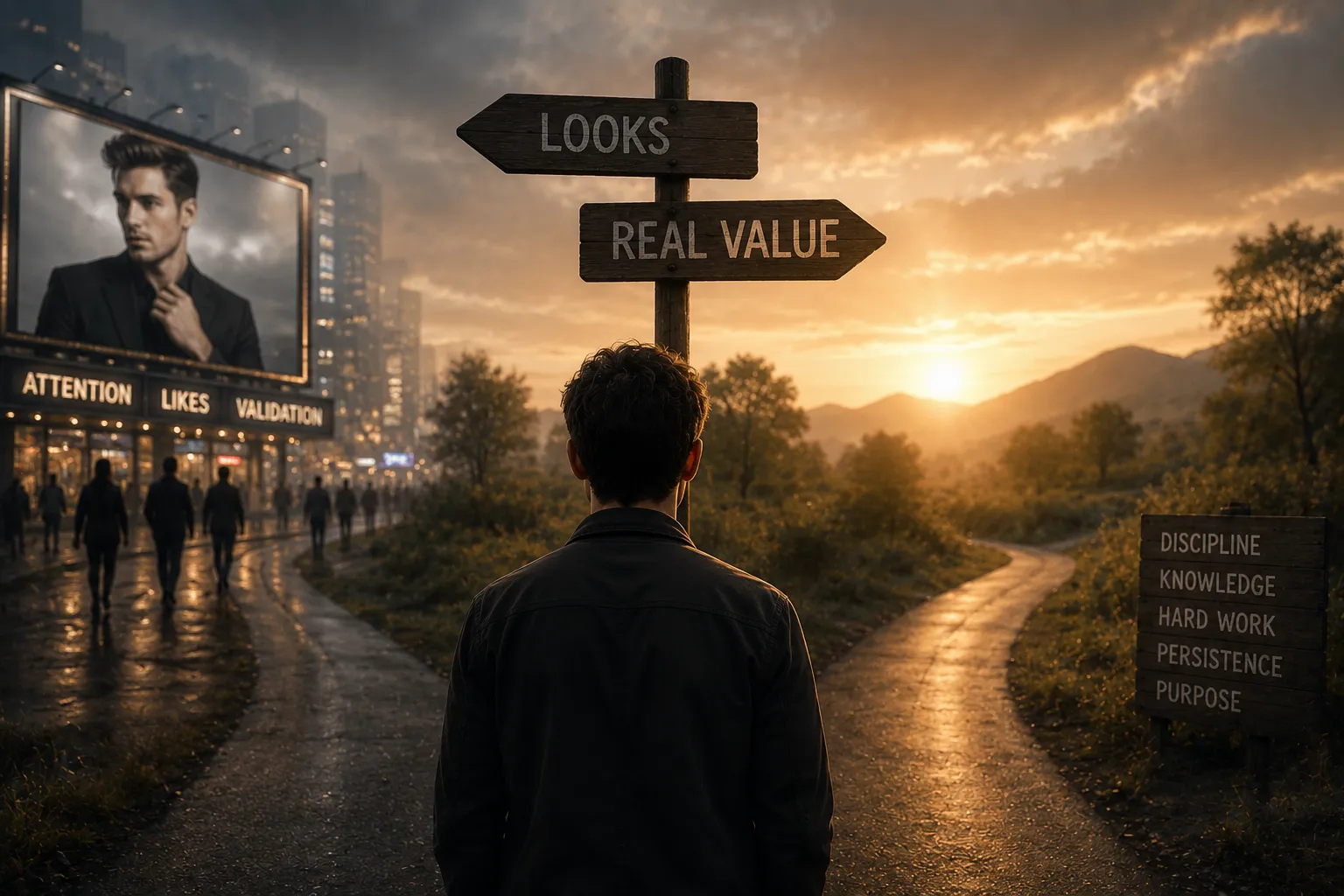
People love giving simple answers to complicated questions.
When the topic of success and physical appearance comes up, discussions usually become extremely polarized. Some people insist appearance means almost everything. Others claim looks don’t matter at all and that personality, intelligence, and hard work are the only things that truly count.
Honestly, I think both sides oversimplify reality.
Physical appearance absolutely affects the way people are treated. Research supports this very clearly. At the same time, appearance alone is nowhere near enough to build long-term success, respect, meaningful relationships, or real confidence.
The truth is more uncomfortable than either extreme.
Looks matter.
But not in the simplistic way social media often presents them.
irst Impressions Are Built Extremely Fast
Whether people like it or not, humans naturally form first impressions very quickly. Before someone even speaks, the brain already notices:
- posture,
- facial expressions,
- grooming,
- clothing,
- eye contact,
- body language,
- overall presence.
Researchers from Princeton University found that people can form impressions about trustworthiness, competence, and attractiveness within fractions of a second.
That may sound unfair, but it’s part of human psychology. The brain constantly makes quick judgments as a survival mechanism.
And honestly, pretending this doesn’t happen feels unrealistic.
Attractive people often receive certain advantages:
- more attention,
- better first impressions,
- greater social openness,
- sometimes even better professional opportunities.
This phenomenon is sometimes called the “halo effect,” where people unconsciously assume physically attractive individuals also possess other positive qualities.
Social Media Made Appearance More Important Than Ever
I think modern technology dramatically intensified this issue.
For most of history, people mainly compared themselves to people around them:
- classmates,
- coworkers,
- neighbors,
- friends.
Now millions of highly edited faces appear on screens every day. Social media created an environment where appearance is constantly evaluated, filtered, optimized, and compared.
Platforms reward visual appeal aggressively because attention itself became profitable.
People now spend enormous amounts of time:
- editing photos,
- analyzing imperfections,
- comparing themselves,
- chasing unrealistic standards,
- seeking validation through likes and attention.
And honestly, I think many people underestimate how psychologically damaging this constant comparison can become.
Research from American Psychological Association has discussed links between social media exposure, body image issues, anxiety, and reduced self-esteem.
The strange thing is that even people who intellectually understand filters and editing still emotionally compare themselves to unrealistic images.
Confidence Often Matters More Than Perfect Features
One thing I’ve personally noticed is that confidence changes how appearance is perceived.
There are people with objectively attractive features who still seem insecure, uncomfortable, and emotionally closed off. At the same time, there are individuals who may not fit modern beauty standards perfectly but still attract enormous respect and attention because of:
- confidence,
- charisma,
- humor,
- communication,
- energy,
- emotional intelligence.
This is something social media often ignores because confidence is harder to photograph than appearance.
And honestly, some of the most memorable people are not necessarily the most conventionally attractive. They simply have presence.
That presence often comes from how someone carries themselves rather than perfect facial structure.
Grooming and Self-Care Matter More Than Genetics for Most People
This is another reality many discussions ignore.
People often talk about appearance as if success depends entirely on genetics, but in everyday life, basic self-care has enormous influence:
- hygiene,
- fitness,
- posture,
- sleep,
- clothing,
- skincare,
- communication style,
- health.
Most people are not competing against supermodels in normal life. They are interacting with ordinary people in workplaces, social environments, relationships, and business situations.
And honestly, someone who takes care of themselves consistently usually creates a stronger impression than someone relying purely on natural attractiveness.
I think this is actually a healthier way to approach appearance because it shifts focus from impossible perfection toward controllable habits.
Attractive People Do Receive Advantages
At the same time, I don’t think it’s honest to pretend appearance has no real-world effects.
Research has repeatedly shown that attractive individuals may receive advantages in:
- hiring,
- dating,
- networking,
- customer-facing jobs,
- social treatment.
Economists and psychologists have sometimes referred to this as “beauty premium.”
Studies discussed by researchers from Harvard University and other institutions suggest appearance can influence economic outcomes and social opportunities.





Leave feedback about this