

Almost everyone has experienced this cycle at some point.
You watch an inspiring video, read a powerful quote, listen to a successful person talking about discipline and hard work, and suddenly you feel unstoppable. You promise yourself that things will finally change. You’ll wake up earlier, start working out, study consistently, launch the project you’ve been delaying, or completely rebuild your life.
And for a few days, sometimes even a few hours, it feels real.
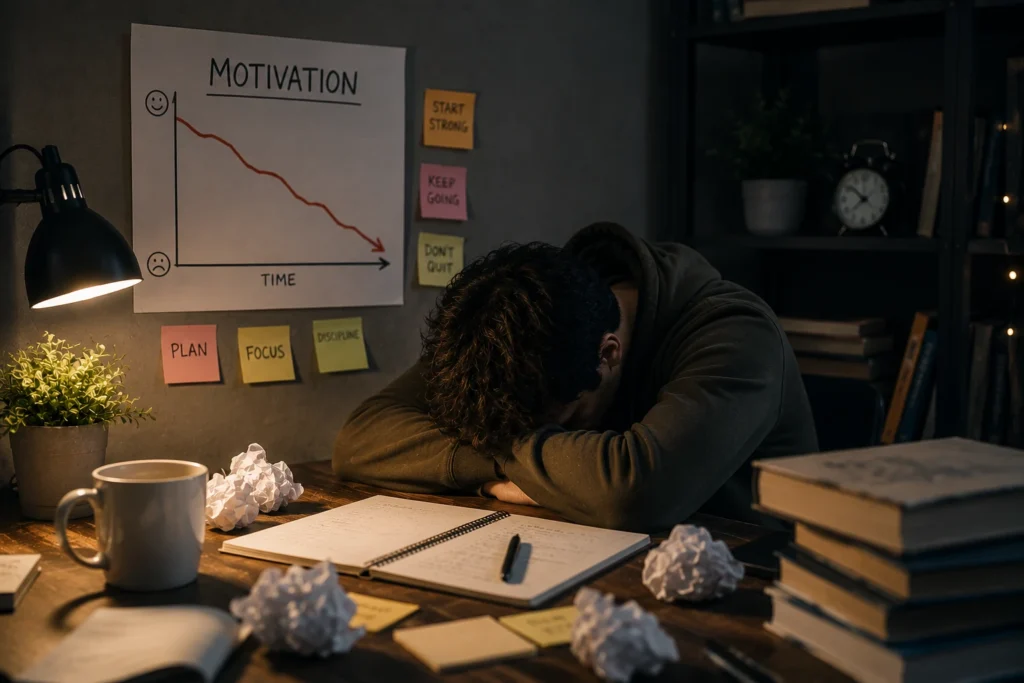
Then motivation disappears.
The energy fades, the excitement becomes weaker, and slowly old habits return. People often blame themselves when this happens. They think they’re lazy, weak, inconsistent, or simply incapable of success. But honestly, I don’t think the problem is usually laziness. I think most people misunderstand what motivation actually is and expect it to do something it was never designed to do.
Modern culture treats motivation almost like a permanent fuel source. Social media constantly pushes the idea that successful people are endlessly driven and inspired every day. But real life rarely works that way. Motivation is emotional. Emotions change constantly. That means motivation naturally rises and falls too.
The problem is that many people build their entire plans around temporary emotional energy instead of stable systems and habits.
Motivation Is Designed to Be Temporary
One of the biggest misconceptions about motivation is the belief that it should last forever once you “find your purpose.” In reality, motivation evolved as a short-term psychological mechanism that pushes people toward action during emotionally important moments.
Researchers studying dopamine and reward systems have shown that the brain responds strongly to novelty, anticipation, and emotional excitement. That initial burst of energy people feel at the beginning of a new goal is often connected to anticipation more than the work itself.
This explains why starting feels exciting while continuing feels difficult. At the beginning, the brain imagines the future reward:
- getting fit,
- becoming successful,
- making money,
- improving life,
- gaining confidence.
But once repetitive work begins, emotional excitement naturally decreases. The brain adapts very quickly to routines, even positive ones. That adaptation is normal, but many people incorrectly interpret it as failure.
Personally, I’ve noticed that the hardest part of almost any long-term project comes after the initial excitement disappears. The beginning feels emotionally rewarding because everything is still new. But real progress usually starts when the emotional high fades and consistency becomes more important than excitement.
Social Media Created Unrealistic Expectations About Productivity
I honestly think social media made this problem much worse.
Every day people see highly edited videos showing perfect routines:
- waking up at 5 AM,
- cold showers,
- perfect workouts,
- clean desks,
- endless discipline,
- nonstop productivity.
The problem is not inspiration itself. The problem is that these videos compress months or years of effort into short emotional moments. They make discipline look cinematic instead of repetitive.
Real self-improvement is usually boring.
It often involves:
- repetition,
- discomfort,
- slow progress,
- invisible results,
- frustrating setbacks.
And because modern content is optimized for emotional impact, people become addicted to the feeling of motivation itself instead of building sustainable habits.
I think many people today consume motivation the same way people consume entertainment. They watch videos that make them feel temporarily inspired, but that emotional rush disappears quickly because no real system exists underneath it.
Dopamine Makes New Goals Feel More Exciting Than Old Ones
Another reason motivation disappears quickly is because the brain loves novelty.
Starting something new produces uncertainty, anticipation, and excitement. The brain reacts strongly to these feelings because novelty activates dopamine systems connected to reward prediction.
Researchers from Stanford University and other institutions studying behavioral psychology have explored how dopamine responds more strongly to anticipation than to long-term repetition.
This is why people often:
- start new diets repeatedly,
- constantly switch goals,
- abandon projects halfway,
- jump between hobbies,
- search for “life-changing” routines.
The brain enjoys the emotional excitement of starting more than the discomfort of maintaining consistency.
Honestly, I think this is one reason modern people struggle so much with long-term focus. There are simply too many new sources of stimulation available all the time. Every app, platform, and algorithm competes for attention by offering novelty.
Discipline becomes difficult when distraction is always easier and emotionally more rewarding in the short term.
Motivation Depends Too Much on Emotion
One dangerous thing about relying entirely on motivation is that emotions are unstable by nature.
Some days people feel confident.
Other days they feel anxious.
Sometimes energy is high.
Sometimes the brain feels exhausted for no obvious reason.
If productivity depends entirely on emotional state, consistency becomes impossible.
This is why many successful people talk more about systems and routines than motivation itself. They understand that emotions cannot always be trusted.
James Clear frequently discusses the importance of building habits that reduce dependence on emotional motivation. Small consistent actions often produce more long-term results than rare bursts of extreme motivation.
Personally, this was one of the hardest lessons for me to understand. I used to think productive people simply felt motivated all the time. Over time, I realized many successful people continue working even when motivation completely disappears. They rely on structure instead of emotional excitement.

Perfectionism Quietly Kills Motivation
This is another huge problem that people rarely notice.
Many individuals begin goals with unrealistic expectations:
- perfect consistency,
- immediate results,
- zero mistakes,
- constant progress.
Then the moment something goes wrong, motivation collapses.
Missing one workout becomes:
“I failed.”
One unproductive day becomes:
“I’m falling behind.”
This kind of thinking destroys long-term consistency because perfection is impossible.
Ironically, people who make steady progress are often more forgiving toward themselves. They expect setbacks and continue anyway.
I honestly think perfectionism creates more procrastination than laziness does. When people become obsessed with doing everything perfectly, starting feels emotionally dangerous because failure feels personal.
Modern Life Constantly Drains Mental Energy
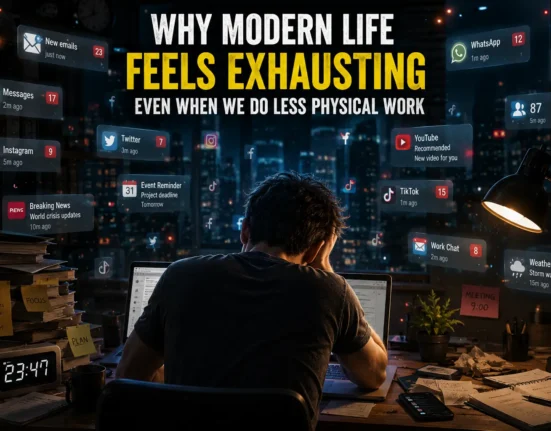
There’s also another reality people underestimate: modern life itself is mentally exhausting.
Attention is constantly attacked by:
- notifications,
- social media,
- work stress,
- financial anxiety,
- information overload,
- comparison culture.
Mental exhaustion reduces motivation naturally.
Sometimes people don’t lack ambition. They simply lack cognitive energy.
Researchers from American Psychological Association have repeatedly discussed how chronic stress affects motivation, focus, and emotional regulation.
I think many people judge themselves too harshly without recognizing how psychologically overstimulating modern life became. The brain was not designed to process constant stimulation every waking hour.
Discipline Is More Reliable Than Motivation
This is probably the most important realization.
Motivation is useful for starting.
Discipline is what keeps things moving afterward.
That doesn’t mean discipline feels exciting. Most of the time it feels ordinary. Sometimes it even feels uncomfortable. But unlike motivation, discipline survives emotional fluctuations.
People who achieve long-term goals usually learn how to continue even during periods of low energy and low inspiration.
And honestly, that’s where real transformation happens.
Not during the emotionally intense beginning.
Not during the motivational speeches.
Not during the perfectly planned routines.
Real progress usually happens quietly through repeated actions that feel almost boring in the moment.
Small Habits Matter More Than Intense Bursts
One thing I’ve noticed repeatedly is that people often underestimate small consistent effort because modern culture glorifies dramatic change.
But sustainable growth usually looks less impressive:
- reading 10 pages daily,
- exercising consistently three times a week,
- writing a little every day,
- reducing distractions gradually,
- improving routines slowly.
These actions don’t create instant emotional excitement, but over months and years they completely change people’s lives.
The brain adapts more easily to small consistent habits than to extreme temporary changes.
Final Thoughts
I honestly don’t think motivation is the problem.
The real problem is that many people expect motivation to carry them through processes that actually require patience, structure, and consistency. Motivation naturally disappears because emotions naturally change. That’s normal human psychology, not personal failure.
Modern life also makes sustained focus harder than ever. Constant stimulation trains the brain to seek novelty and instant rewards, while meaningful goals usually require repetition and delayed gratification.
The people who eventually succeed are not always the most motivated people. Very often, they are simply the people who continue after motivation fades.
And maybe that’s the most important difference of all.
Written by Garegin
See also:
why modern life constantly drains mental energy
how overthinking destroys consistency and focus





Leave feedback about this