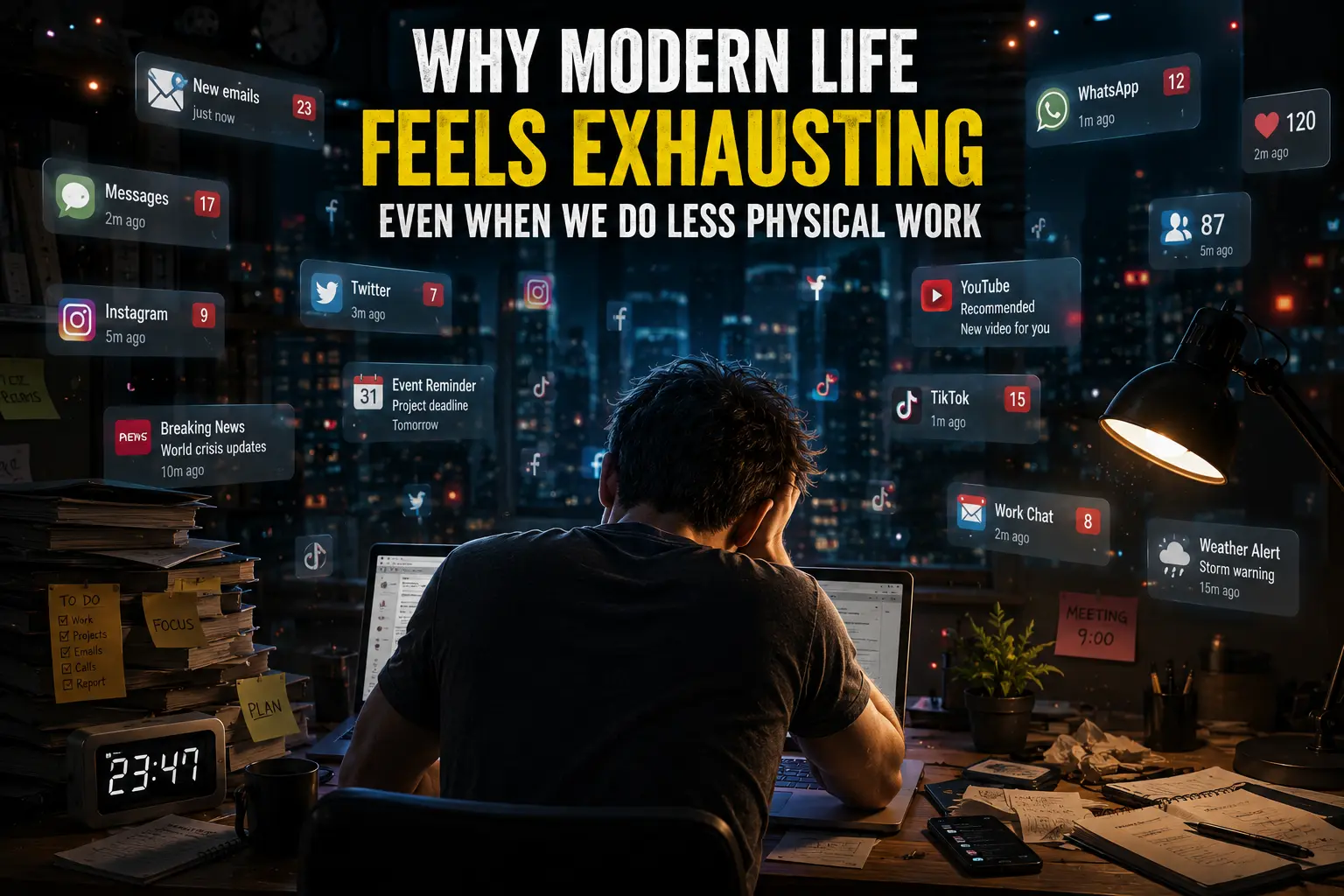
Most of us no longer work in factories. We don’t spend our days carrying heavy objects, farming land, or doing physically exhausting labor for 14 hours straight. Technology automated many difficult tasks. In theory, life should feel easier than ever. And yet, so many people feel mentally exhausted all the time. Not just tired — exhausted.
You wake up tired.
You scroll while tired.
You work while tired.
You rest while tired.
I’ve honestly started noticing this everywhere. People constantly talk about burnout, anxiety, overstimulation, lack of focus, and emotional fatigue. Even weekends often don’t feel like real recovery anymore. And I don’t think it’s because modern people are “weaker.”
I think modern life itself became psychologically overwhelming in ways human brains were never designed for.
Our Brains Never Truly Rest Anymore
One of the biggest differences between modern life and life 30 years ago is simple: The brain no longer gets silence.
There is always something happening:
- notifications,
- emails,
- news,
- social media,
- messages,
- videos,
- advertisements,
- algorithms competing for attention.
Even during moments that are supposed to be relaxing, many people immediately reach for their phones.
Waiting in line?
Phone.
Eating alone?
Phone.
Lying in bed?
Phone.
The brain rarely experiences boredom anymore — and boredom used to be important.
Researchers from Harvard University have discussed how constant digital stimulation affects attention, stress levels, and cognitive fatigue.
Personally, I’ve noticed that my brain feels more exhausted after three hours of fragmented scrolling than after several hours of focused work. That says a lot.
Notifications Are Quietly Destroying Focus
Modern technology doesn’t just interrupt us physically — it interrupts us mentally. A single notification may seem harmless. But dozens of interruptions every day constantly reset attention. And attention is expensive.
According to research from University of California, Irvine, it can take over 20 minutes to fully regain focus after an interruption.
Think about that for a second. Most people receive interruptions constantly:
- Instagram notifications,
- Telegram messages,
- emails,
- work chats,
- YouTube recommendations,
- news alerts.
No wonder deep concentration feels rare now. I honestly think many people don’t even realize how mentally fragmented they’ve become because fragmented attention has become normal.
We Consume More Information in One Day Than People Once Consumed in Weeks
The human brain evolved for survival, social connection, and small communities.
It did not evolve to process:
- global tragedies,
- political outrage,
- celebrity scandals,
- economic fear,
- viral arguments,
- productivity advice,
- AI news,
- financial stress,
- thousands of opinions daily.
And yet this is exactly what happens now. The internet gives us access to infinite information, but human attention is still limited. That creates overload.
American Psychological Association has repeatedly discussed how information overload contributes to stress and mental fatigue.
Sometimes I genuinely think the brain spends more energy filtering useless information than solving real problems.
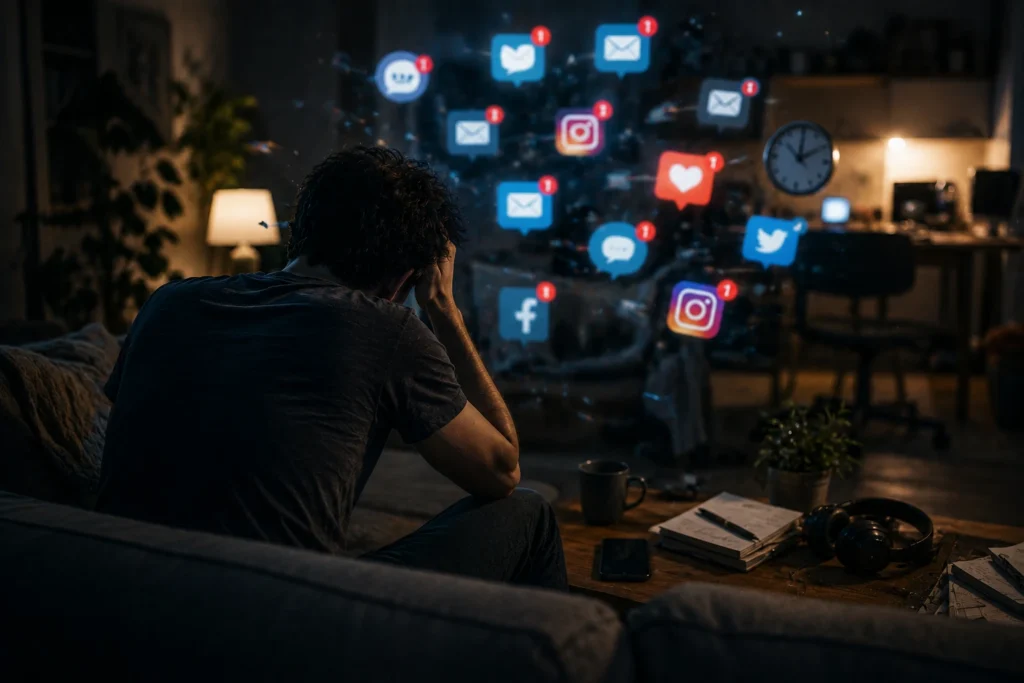
Social Media Created Permanent Comparison
This may be one of the most psychologically damaging parts of modern life. For most of human history, people compared themselves to a relatively small group:
- neighbors,
- coworkers,
- classmates,
- relatives.
Now we compare ourselves to millions of people every day. And usually not even to their real lives — only to their highlights.
Someone is richer.
Someone travels more.
Someone looks better.
Someone is more successful.
Someone is younger and already ahead.
Even when people consciously know social media is filtered and unrealistic, the brain still reacts emotionally. I think this creates invisible stress that many people underestimate.
Research from University of Pennsylvania found links between social media use and increased feelings of loneliness and depression.
Honestly, I’ve noticed that sometimes people aren’t even tired from work itself anymore. They’re tired from constantly feeling behind.
Modern Work Rarely Has Clear Endings
Physical labor used to have visible endings. You finished building something. You finished harvesting. You finished fixing something. Modern digital work often never feels finished.
There is always:
- another email,
- another update,
- another message,
- another optimization,
- another notification,
- another task waiting online.
Especially in digital industries, work psychologically follows people home. Laptops and smartphones erased the boundary between “working” and “not working.” And when the brain never fully disconnects, exhaustion becomes permanent background noise.
The Brain Was Not Designed for Constant Dopamine
Apps today are designed to compete for attention. Not casually. Aggressively. Social media platforms, short-form videos, and algorithms constantly trigger dopamine systems in the brain through:
- unpredictability,
- novelty,
- rewards,
- endless scrolling.
The problem is that overstimulation changes how normal life feels.
Simple activities like:
- reading,
- walking,
- deep conversations,
- studying,
- quiet thinking,
start feeling “too slow.”
That’s dangerous.
Researchers from Stanford University and other institutions studying behavioral psychology have explored how digital reward systems affect attention and habit formation.
I honestly think many people are not physically tired anymore — they are neurologically overstimulated.
Why Mental Exhaustion Feels Different From Physical Exhaustion
Physical exhaustion often feels clean. You rest. You sleep. You recover. Mental exhaustion is different. You can spend an entire day sitting and still feel completely drained. Because the brain consumes enormous energy when constantly switching attention, processing information, regulating emotions, and handling stress.
And unlike physical labor, mental fatigue is invisible. That invisibility makes it harder to explain — even to ourselves.
Boredom Used to Be Healthy
This is something modern life almost eliminated. Boredom sounds negative, but historically it gave the brain space to:
- reflect,
- imagine,
- process emotions,
- think deeply,
- recover attention.
Now boredom gets instantly destroyed by screens. Even five seconds of silence feel uncomfortable for many people. And honestly, I think that’s one reason creativity feels harder today. The brain needs empty space sometimes.
So What Can We Actually Do?
I don’t think the solution is abandoning technology completely. That’s unrealistic. Modern technology also brings enormous advantages:
- education,
- connection,
- opportunities,
- creativity,
- remote work,
- business growth.
The real challenge is learning how to use technology without allowing it to consume attention completely. Some things that genuinely help:
- disabling unnecessary notifications,
- reducing endless scrolling,
- taking walks without phones,
- doing focused work sessions,
- sleeping away from screens,
- creating periods of silence during the day.
Ironically, protecting attention may become one of the most valuable skills of the future.
Final Thoughts
Modern life looks easier physically than life in the past. But psychologically, it may be more demanding than ever. Our brains now live inside a nonstop stream of information, comparison, stimulation, pressure, and interruption. And most people never truly disconnect from it. I honestly don’t think humans are bad at handling modern life. I think modern life simply evolved faster than the human brain did.
And maybe the first step toward feeling better is understanding that constant exhaustion isn’t always laziness or weakness. Sometimes it’s the natural result of living in a world that never stops talking.
Written by Interest Story Editorial Team
We publish personal growth, emotional wellbeing, and self-improvement articles designed to encourage healthier thinking patterns, emotional awareness, and meaningful long-term progress.
See also:
why overthinking slowly destroys focus


Leave feedback about this